of third party breaches now target the software and technology supply chain
page security questionnaires arriving with every enterprise health system contract
average healthcare breach cost, the costliest sector for the 14th year (IBM 2025)
typical TripleKey onboarding for vendors. Read only access, zero pipeline change
Three forces are reshaping every enterprise healthcare deal at once. Hospitals are pushing BAA accountability downstream. Cyber insurers are tightening underwriting. And cybercriminals have realized that the fastest way into a hospital is through one of its software vendors. Your customers feel all three. Now they're asking you to prove you've handled them.
Health system procurement and CISO teams now treat the vendor security questionnaire as a real gating step. SBOMs, dependency lists, contributor attestations, and continuous monitoring evidence are showing up at renewal, not just at first sale. One unanswered question can stall a six figure deal for an entire quarter.
90 days
The Business Associate Agreement has always made you accountable for PHI. Newer addendums make you accountable for the open source dependencies, contributor risk, and license posture inside the software handling that PHI. SOC 2 and HITRUST do not cover this. Your clients know that, and so do their auditors.
58%
Series B due diligence and M&A buyer technical review have caught up. Code health, dependency risk, contributor provenance, and SBOM availability are line items now. A weak software supply chain story does not just slow a sales cycle, it shows up in a term sheet, a valuation, and a final close.
48,185
When a health system runs TripleKey, every software vendor they depend on appears in one sortable table: risk score, critical risks, exposed secrets, last scan. The security review does not start when procurement emails you the questionnaire. It starts here, before you are in the room.
Risk score is a sortable column, and your number sits directly beside every competing vendor in the buyer's stack. Security teams sort by score before they sort by anything else.
A scan from 73 days ago renders in red, and the buyer sees it before anyone emails you. Continuous daily verification means your row never tells that story.
Invited vendors sit in awaiting completion until they connect. To the buyer, a blank row next to a competitor's verified 92 reads like a risk decision already made.
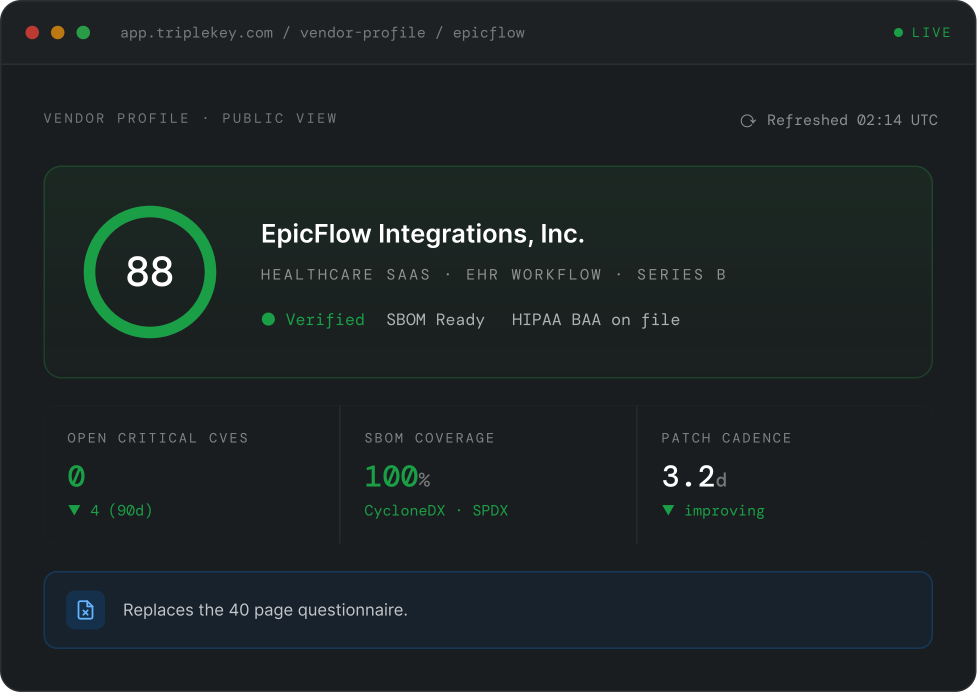
Every healthcare technology vendor on TripleKey gets a live, third party verified Vendor Profile. A Tech Risk Score refreshed every twenty four hours. SBOM ready in CycloneDX or SPDX. CVE posture, license posture, and contributor risk, all forensically measured by an independent platform. You share one link with the prospect's CISO, and the security review stops being a fire drill.
Most security tools land in your codebase the same way. An agent in your CI. A new step in your pipeline. A blocking gate on your release. Your engineering leaders push back, the rollout stalls, and the security review request from the prospect goes unanswered for another quarter.
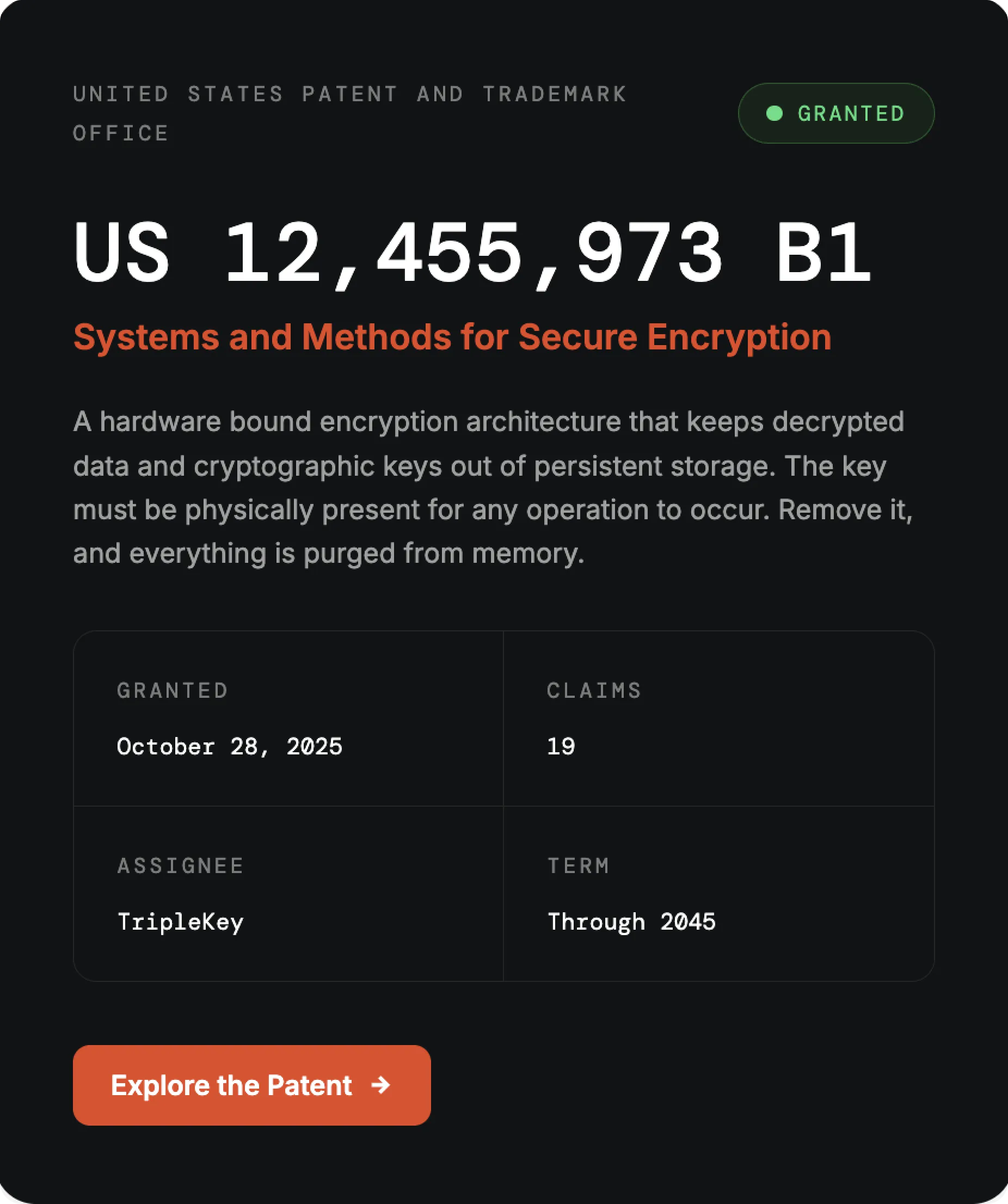
TripleKey is built differently. The architecture sits entirely outside your build pipeline, and everything we analyze is protected by TripleKey's patented encryption (US 12,455,973 B1). There is nothing to install, nothing to maintain, and nothing that can break a deployment. Your engineers grant read only access to your repositories, and the daily scans begin. That is the entire integration.
TripleKey was designed to be a routine input for your CTO, your VP of Sales, and your Compliance lead, not a heavy implementation. The first scan runs the day you connect, and the live Vendor Profile is shareable inside the first week.
Your engineering team grants read only access to the repositories you want covered. No agents, no CI changes, no engineering sprint. Most complete this step in under 10 minutes.
TripleScan inventories every dependency, flags every CVE and license conflict, and produces your Tech Risk Score per product, refreshed every twenty four hours.
You get a customer ready Vendor Profile link, plus on demand SBOM in CycloneDX and SPDX formats. Quarterly trend views generate automatically for renewal conversations and board reporting.
Replace the questionnaire. Drop the Vendor Profile link into every security review, RFP response, BAA addendum, and underwriter renewal. The security stage stops being a deal blocker.
The Vendor Profile is built so your CTO, your CRO, and your Compliance lead each get the proof they need, generated from the same daily scan. Engineering ships faster. Sales closes faster. Compliance sleeps better.
Stop owning a security tool you have to defend in every standup. TripleKey is out of pipeline, read only, and zero maintenance. Your team ships at the same speed and your dependency risk gets handled in the background.
Turn the security review from a deal killer into a competitive advantage. Drop a single Vendor Profile link into the procurement portal. Close the security stage in days, not quarters. Win deals where less prepared competitors get stuck.
Make every BAA addendum, OCR inquiry, SOC 2 Type II prep, and cyber insurance renewal answerable from one place. Continuous, third party verified evidence beats annual self attestation, every audit, every time.
Healthcare technology vendors typically see Vendor Profile participation pay for itself the first time it pulls a single deal forward by a quarter. The benefits compound across every renewal, every security review, and every underwriter conversation that follows.
Typical reduction in time spent in the security review stage when a TripleKey Vendor Profile is shared at procurement.
Engineering hours required after read only access is granted. No CI integration, no agent maintenance, no upgrade cadence.
Average reduction in compliance and engineering hours spent on enterprise security questionnaires once the Vendor Profile is the answer.
When invited by a participating health system customer, your participation is no charge. The dashboard travels with you to every other deal.
SOC 2 and HITRUST are still required and still important. They are not enough on their own anymore. Health system CISO teams now expect continuous dependency evidence and an SBOM on file, not just an annual letter.
CTO, Series B Healthcare SaaS
TripleKey customer · Vendor Profile shared with 12 enterprise health systems
Almost never. The integration is read only repository access, the architecture is designed to stay out of your pipeline, and there is no agent, no CI hook, and no maintenance burden. Scan data is protected by TripleKey's patented encryption. Most CTOs sign off in the first conversation once they see what is and is not being asked of their team.
Snyk and Dependabot live inside your pipeline and flag issues at scan time for your engineers. TripleKey produces independent, third party verified evidence your customers and underwriters will actually accept. The two are complementary. Only TripleKey clears the security review.
When a TripleKey health system customer invites you, there is never a cost to share your score. After 14 days, you may choose to upgrade to a paid account in order to keep the same functionality you experienced during the trial period.
It complements both. SOC 2 and HITRUST cover controls and processes at a moment in time. TripleKey covers the actual code and dependencies inside your software, daily. Health system CISOs now expect both. Cyber insurance underwriters increasingly do too.
Yes. The Vendor Profile is yours to share with any prospect, customer, auditor, or underwriter who asks for security evidence. If they do not have an account, you can easily send them a PDF.
Contractor and offshore commits are in scope by default for every repository you connect. TripleKey surfaces contributor anomalies, license posture, and dependency risk regardless of whether the code came from a full time employee or a third party developer.
The External Scan is TripleKey's outside in view of your software: the same attacker visible surface a health system security team checks before your first call. Submit a URL and get a letter grade from A through F across five audit categories, with findings explained in plain language. No code access, no agent, no IT project.
Two scores, two questions. The External Scan grades what an outsider can see of your live application, A through F. The Tech Risk Score measures what is inside the code itself, 0 to 100. Enterprise security reviews increasingly ask about both.
Grant read only access and we will walk you through what your live Vendor Profile would look like, what an enterprise health system CISO would see when you share the link, and how the security review changes when the answer is one click away.