of breaches now involve a third party, double the prior year. Your client's vendor is often you.
new secrets exposed in public GitHub commits in 2025, up 34% year over year.
the baseline rate at which AI assisted commits leak secrets, raising the bar on what counts as proof.
more expensive to clean up a supply chain incident than a first party breach.
When you hand off a project, the client inherits everything inside it: your dependencies, your contractors' commits, and any credential that slipped into the history. Most shops can describe how careful they were. Very few can show it. That gap is where deals stall, final invoices get held, and references quietly go cold.
The traditional handoff relies on assurances no one can verify. The client takes your word, signs off, and discovers the gaps later when an auditor, an acquirer, or an incident forces the question.
TripleScan reads your repositories with a read only token and produces a continuous, dated record of the code's health and authorship. You deliver the software and the proof in the same package.
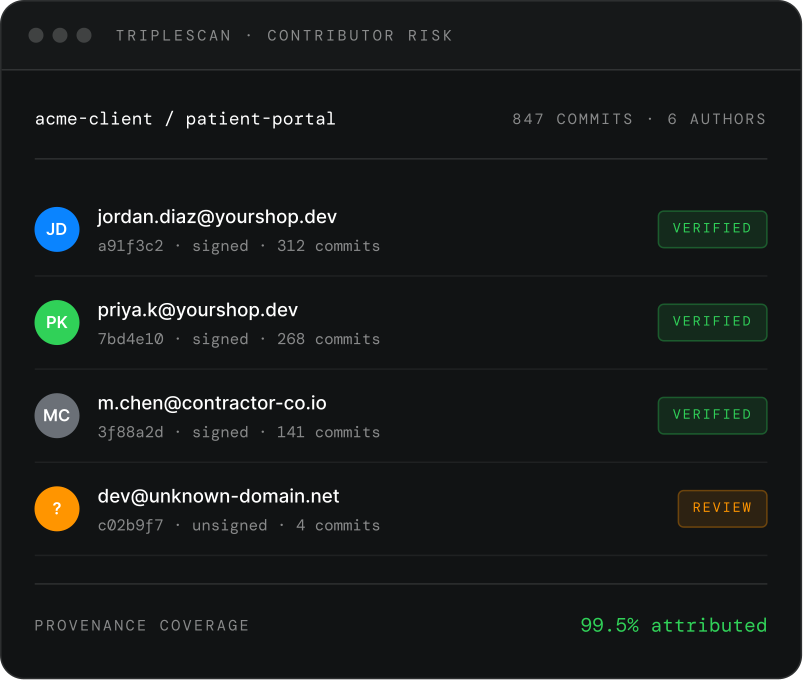
TripleScan's Contributor Risk and Code Provenance analysis verifies authorship across every commit in every repository. It separates the contributors you authorized from the ones you did not, and it gives the client a record they can hold onto long after the engagement ends. This is the difference between saying your team built it and showing exactly who built each part.
Verified versus unverified author signing across every commit and every repository.
Email domain verification against your expected roster of contributors and subcontractors.
Commit pattern anomaly detection across active branches, surfacing unexpected authorship before the client does.
Visibility into offshore, contractor, and vendor commits, so delegated work is documented rather than assumed.
Each engagement produces a set of board ready and audit ready documents. They travel with the code, so the client can answer their own security questions without coming back to you, and you can point to them in your next sales conversation.
A 0 to 100 score with a 90 day trend that the client's board, buyer, and insurer all read the same way. The number you delivered at, in writing.
A defensible, per repository record of who authored what, with verified and unverified contributors clearly separated.
A complete software bill of materials across direct and transitive dependencies, kept current rather than frozen at a point in time.
Daily scanning matched against the global CVE database, with CVSS and exploit probability so the client sees what was open and what you closed.
Open source license metadata with copyleft and commercial conflicts surfaced before handoff, not in a customer audit two quarters later.
Full history scanning for credentials, tokens, and keys committed by accident, so nothing sensitive rides along into production.
You connect once at the start with a read only repository token. No agents, no pipeline changes, no engineering lift. From there, the record accumulates on its own, so the handoff package is ready the day the project ships.
Connect the client's repositories with a read only token. TripleScan establishes a starting Tech Risk Score and an initial contributor roster before the first sprint closes.
Every 24 hours, the scan refreshes. New dependencies, new contributors, and new findings are dated and attributed as the work happens, not reconstructed at the end.
At delivery, the client receives the build alongside a dated record of its health and authorship. The score trend tells the story of the engagement in a single chart.
Custom shops, staff augmentation, and product studios all carry the same burden: convincing a client that delegated work is safe and accounted for. TripleScan adapts to each model without changing how your teams work.
You deliver a finished application the client will own and operate. They need confidence it is safe to run and clear on who wrote it.
Your developers work inside the client's repositories alongside their own staff and other vendors. Authorship gets muddy fast.
You run many engagements at once and resell trust as part of the offering. A consistent proof package becomes a competitive advantage.
Representative situations where a documented record of safety and authorship protected a development shop, accelerated a handoff, or won the next engagement.
A client's incoming CISO required proof of code safety before releasing the final milestone payment. The shop produced a current SBOM, a CVE inventory, and a complete provenance trail rather than scrambling for documentation that did not exist.
An augmented team shared repositories with the client's internal staff and a second vendor. When an unverified commit introduced a risky dependency, the question of who was responsible turned tense.
A history sweep before delivery surfaced a live cloud credential committed months earlier during a rushed prototype phase. It had never been rotated and would have traveled into the client's production environment.
A studio competing for an enterprise account was not the cheapest bidder. It was the only one that could show a sample handoff package with a real Tech Risk Score trend and a verified contributor record.
Clients are no longer satisfied with a certificate that captured a single moment. With third party involvement in breaches doubling to 30% year over year and AI assisted commits leaking secrets at twice the baseline rate, the buyers you deliver to are asking harder questions. The shops that can answer with evidence will keep winning the work.