
Software risk is now a legal obligation. Can you defend yours in writing?
to file Item 1.05 of Form 8-K once a cybersecurity incident is determined material. The clock starts at materiality, not at discovery.
average cost of a US data breach, the highest of any region. The number that drives shareholder suits, class actions, and consent decrees.
of breaches now involve a third party or software supply chain compromise, double the rate of just one year earlier.
a routine breach notification clock in modern enterprise MSAs and several major regulatory regimes. Faster than most companies can investigate.
Software risk stopped being an engineering matter and became a documented legal obligation.
For years this sat inside the engineering organization. It was a tool spend question that security owned, and you saw a number in an annual report once a year. That arrangement worked when the legal consequences of software risk were small enough to absorb without papering them.
That world is gone. The SEC requires public registrants to disclose material cybersecurity incidents within four business days and to describe their software risk management program in their annual filings. State attorneys general are pursuing vendor mismanagement claims after third party breaches. Enterprise clients embed security warranties, audit rights, and indemnification clauses in every MSA your team signs. Cyber insurance policies attach conditions precedent that turn an unevidenced program into a denied claim. And in M&A, software posture now sits in the representations and warranties section, not the technical exhibits.
An engineering responsibility
A legal obligation you evidence
A warranty clause you negotiate
A warranty clause you can defend
A future disclosure decision
A four business day clock running now
A vendor management policy
A continuous inventory regulators will ask for
That is why this guide exists. Not to turn you into a security buyer, but to give you the evidence trail behind a risk you already sign your name to.
The legal questions you cannot answer yet.
These are not technical questions. They are the questions you get asked at a contract negotiation, a board meeting before a 10-K filing, a notification call after a vendor incident, or a diligence session before a transaction closes. Read each one and ask yourself honestly whether you could answer it today, with documentation, not from memory and not by saying you will check with engineering.
When your CEO signs an MSA with security warranties this quarter, can you evidence the warranty the day it is invoked?
When one of your software vendors is breached, do you have what your regulators, insurer, and enterprise customers will demand in writing?
If a material cybersecurity incident occurs today, can you meet the SEC four business day clock with defensible disclosure language?
If diligence opens your data room next quarter, do your representations and warranties hold up under a sophisticated buyer's questions?
What is your total documented legal exposure to software supply chain risk, and would you defend it under deposition?
The exposure is rarely a single event. It is the SEC enforcement that follows an incomplete 8-K. It is the consent decree imposed after a vendor breach that landed in your customer data. It is the class action that names directors and officers personally, with policy exhaustion as the only ceiling. It is the deal that re-priced because diligence found a component you did not know was there. It is the regulator who treats a missing inventory as evidence of a deficient program, and the customer who exercises termination rights for breach of warranty. Invisible legal exposure does not stay invisible. It is named, dated, and quantified by someone else, usually under oath, usually with you in the room.
The same blind spot, in the three rooms where you sit.
The underlying gap is the same in each room. What changes is who is in the room with you, and what is on the line when it surfaces. As General Counsel you are in all three.
You are signing warranties you cannot personally backstop.
Modern enterprise MSAs include security representations, third party software warranties, audit rights, and breach notification clocks measured in hours. Your team negotiates the language, but the evidence behind it sits in repos you do not read. Without a continuous artifact, every signature is a future dispute waiting on a trigger event.
The clock has started and your evidence is somewhere in engineering.
An incident occurs. The SEC clock, the state law clock, and the contractual clock all start at the same moment, on different timers. You are the one signing the notice letters, advising the disclosure committee, and coordinating with insurance counsel. A current SBOM and risk score is the difference between a defensible notification and a regulatory enforcement matter.
Your reps and warranties are being tested against the underlying code.
Sophisticated buyers test the technical reps against the repositories themselves. Anything the seller could not see in advance becomes a re-price lever, an escrow, or a survival extension. The General Counsel who walks in with a documented score and inventory walks out with closing on the original terms.
And in the audit committee, you are the one who has to explain it.
Boards now treat software supply chain risk as a standing oversight item, and that conversation runs through legal. When a director asks how the company evidences its program, the answer that lands is a documented score, a continuous SBOM, and a dated trail of disclosure decisions. A reassurance from management does not survive a Caremark inquiry anymore. This guide exists so that when the question comes to you, the answer is already on the page.
Three rooms. Three independent voices. One conclusion.
These are not vendors. They are the regulator, the bar association, and the board governance authority. When the people who write enforcement rules, train your in-house team, and oversee your directors all describe the same shift in the same year, the shift is the consensus, not a marketing claim.

Whether a company loses a factory in a fire or millions of files in a cybersecurity incident, it may be material to investors. Investors will benefit if this disclosure is made in a more consistent, comparable, and decision useful way.
Gary Gensler
Chair, US Securities and Exchange Commission, on adopting Item 1.05
A lawyer should keep abreast of changes in the law and its practice, including the benefits and risks associated with relevant technology. The duty of competence is no longer satisfied by a working understanding of legal doctrine alone.
American Bar Association
Model Rule 1.1, Comment 8, on technology competence for attorneys
Directors must make a good faith effort to put in place a reasonable system of monitoring and reporting around mission critical risks. The absence of any reasonable system is itself the breach.
Delaware Court of Chancery
Caremark line of cases, most recently extended by Marchand v. Barnhill and In re Boeing
What invisible risk has cost the General Counsel who did not document it.
None of these are worst case scenarios. They are documented averages drawn from independent research, government enforcement, and case reporting. The point is not fear. The point is that the cost is real, measurable, and already being paid by companies whose legal teams assumed the evidence existed somewhere two levels down.
Now run the math on your own exposure.
The ledger above shows industry averages. Plug in your ARR, your enterprise renewal base, and your contract notification clocks, and see what invisible software risk is actually costing your company.
None of this asks you to read code. It asks you to put an evidence trail behind a risk you already sign.
Every consequence above traces back to the same root cause. The risk was changing daily, no one in a position of legal accountability could see it in time, and no one could produce a current artifact when a regulator, an insurer, a customer counsel, or a buyer's advisor demanded one. The fix is not a larger security team. It is continuous, plain language visibility into a risk you already paper, so it becomes a documented program you can stand behind under deposition instead of a footnote someone else writes for you. That is the entire reason TripleKey exists.
The math your roadmap is already running, whether you watch it or not.
You will quantify this risk eventually, either by modeling it on your roadmap or by absorbing it in slipped launches and churned customers. These are the four lines a CPO usually adds together. Each one on its own exceeds the annual cost of TripleKey. The combined total is not a question of return, it is a question of magnitude.
One artifact you can take into any contract, notification, or disclosure decision.
TripleScan continuously scans your codebase and the components it depends on, then translates everything it finds into a single Tech Risk Score from 0 to 100, with the underlying SBOM and CVE evidence attached. You do not read code. You read the score and the dated artifact behind it, the same way you read an audit opinion, and you walk into the next contract, notification call, or disclosure committee meeting with it ready.
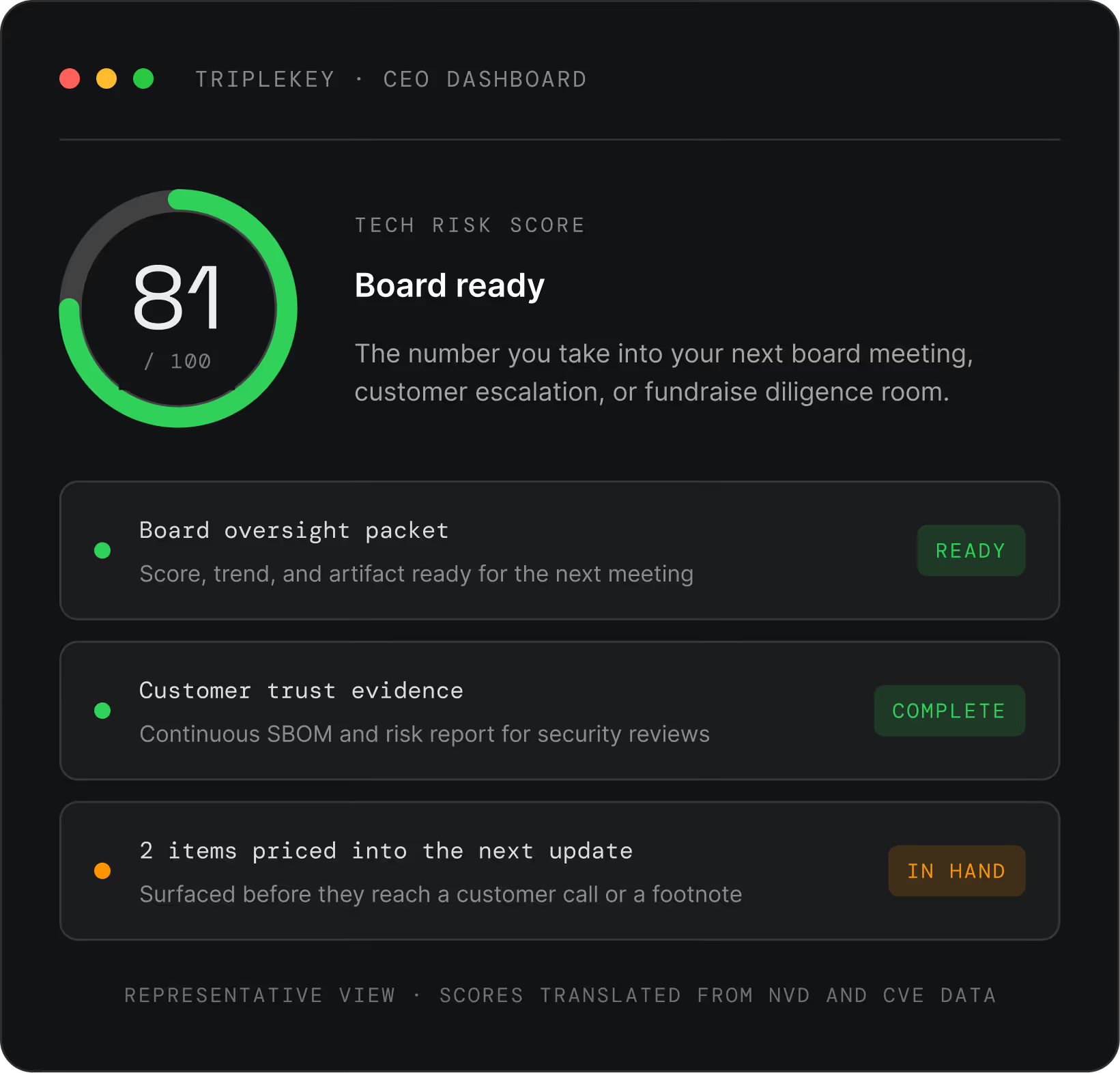
You ask for the artifact. Your engineer produces it.
Getting your first risk score does not require you to touch a line of code. Your role is to start the trial and ask for the artifact. The technical work belongs to the person who already owns it.
01/03 You sign up
02/03 Engineering connects it
03/03 You get the evidence
Tech Risk Score
Continuous SBOM
Disclosure Packet

Walk into the next roadmap review with the number.
The next time a customer counsel, a regulator, your D&O carrier, or your lead investor asks whether you can evidence your software risk program, have a dated artifact ready instead of a referral. Start a free trial, invite your engineering lead, and put the evidence trail behind your signature.