Software risk is a pipeline risk now. Can you forecast yours?
enterprise sales cycles now take roughly three times longer than mid market cycles, driven heavily by security and procurement review.
of B2B buyers say a vendor's security posture is a significant or decisive factor in their purchase decision.
average AE and SE time burned per enterprise deal on security questionnaires, third party risk forms, and follow ups.
of breaches now involve a third party or supply chain compromise, double the rate just one year earlier. Your renewal book sits inside that exposure.
Software risk stopped being a security team artifact and became a sales cycle variable.
For years this sat inside the security team. It was a questionnaire your AE forwarded, a SOC 2 report your CS team emailed once a year, and a footnote nobody on revenue had to model. That arrangement worked when buyers treated security review as a formality and procurement waved deals through.
That world is gone. Enterprise buyers now run formal third party risk programs that gate every meaningful contract. Procurement teams ask for SBOMs and dependency monitoring evidence before they will route a redline. Your customers' CISOs are auditing their existing vendors, including you, mid contract. And your largest accounts now treat a third party breach in your stack as grounds to pause, renegotiate, or walk at renewal. Every one of those moments lands on the revenue org, not on engineering.
A security team artifact
A sales cycle variable you forecast
A SOC 2 report emailed once a year
An evidence packet attached to every deal
A questionnaire your AE chases
A score your AE leads the conversation with
A renewal assumed to be safe
A renewal exposed to third party breach risk
That is why this guide exists. Not to turn you into a security buyer, but to put a number, a packet, and a workflow around a risk that is already eating your cycle time.
The revenue questions you cannot answer yet.
These are not technical questions. They are the questions you get asked in a forecast call, a QBR, a board update, or a customer renewal review. Read each one and ask yourself honestly whether you could answer it today, with numbers, not from memory and not by saying you will follow up after you talk to engineering.
How many days does security review currently add to your enterprise sales cycle?
How much ARR is sitting in security review across your pipeline right now?
When a prospect's CISO asks for your SBOM and dependency monitoring evidence, what does your AE send?
If a third party in your stack is breached, what is the renewal exposure on your top ten accounts?
What is the all in cost of invisible software risk on your number this quarter?
The cost is rarely one event. It is the enterprise deal that slips a quarter because procurement waited on an SBOM you could not produce. It is the AE who lost two weeks of selling time inside one questionnaire. It is the late stage logo that walked because the competitor showed up with a continuous risk score and you showed up with a year old report. It is the strategic renewal that opened mid term because a CVE in a component you did not know was there forced your customer to ask uncomfortable questions. It is the forecast that misses by one deal because nobody on the revenue team had a way to see the bottleneck forming. Invisible risk does not stay invisible. It surfaces on the forecast call, where your number is being judged.
The same blind spot, in the three rooms where you sit.
The underlying gap is the same in each room. What changes is who is in the room with you, and what is on the line when it surfaces. As CRO you are in all three.
Your CEO and CFO want a credible number, not a story.
Late stage deals slipping is the single fastest way to lose forecast credibility. When stalls in security review are invisible, you cannot price them into commit, you cannot warn the room early, and the slip lands as a surprise. With a continuous view of which deals are blocked on which evidence, you can call the number with confidence and defend it.
Your prospect's procurement and security team are gating the close.
Enterprise procurement now treats third party software risk as a hard gate, not a checkbox. When your AE walks in with a current risk score, an SBOM, and proof of continuous monitoring, the conversation accelerates. When your AE walks in with a year old PDF, the deal goes back into the queue and the timeline slips again.
Your largest customers are reauditing the vendors they already trust.
Strategic accounts now run mid contract vendor reviews triggered by industry incidents, regulatory shifts, or their own board pressure. The customers most likely to expand are the ones you can evidence trust to without scrambling. The customers most at risk of churn are the ones you only contact at renewal.
And at Series A and B, there is no Chief Trust Officer to hide behind.
At your stage there is usually no Chief Trust Officer, no dedicated security sales engineer, and often no dedicated security leader. When a prospect's CISO asks for the packet, when a customer asks why your dependency stack changed, when the CEO asks why a deal slipped, the question comes back to you. This guide exists so that when it does, you can put a score, a packet, and a workflow on the table, rather than a promise to circle back with engineering.
Three rooms. Three independent voices. One conclusion.
These are not vendors. They are the analyst, the buyer, and the auditor. When the people who define your sales motion, sign your contracts, and oversee your customers all describe the same shift in the same year, the shift is the consensus, not a marketing claim.

Only 7 percent of sales teams achieve forecast accuracy of 90 percent or more, and 69 percent of sales operations leaders say forecasting is harder than it was three years ago.
Gartner
The benchmark research CROs and sales operations leaders report against.
Early adopters of SBOM and continuous component monitoring gain tangible commercial advantages: reduced sales cycles, access to regulated sectors, and premium pricing that competitors without SBOM capabilities cannot match
Future Market Insights
Independent research on the software supply chain compliance market.
The average vendor now responds to 37.3 security assessment requests every month, up from 29.5 the year prior. Buyers and customers are auditing their software supply chains more aggressively than at any point in the past decade.
Safe Security
Vendor risk assessment benchmark across enterprise security programs.
What invisible risk has cost the CROs who did not measure it.
None of these are worst case scenarios. They are documented averages drawn from independent research and buyer behavior reporting. The point is not fear. The point is that the cost is real, measurable, and already being paid by revenue orgs that assumed security review was somebody else's problem.
Now run the math on your own revenue.
The ledger above shows industry averages. Plug in your ACV, cycle length, and pipeline, and see what invisible software risk is actually costing your number this quarter.
None of this asks you to evaluate a security tool. It asks you to put a workflow around a risk that is already inside your deals.
Every consequence above traces back to the same root cause. Your buyers and your customers are pricing third party software risk into their decisions in real time, and your revenue team has no continuous view of where you stand. The fix is not a bigger security budget. It is continuous, plain language visibility your AEs and CS team can use in front of a prospect or a customer the same day, so risk becomes a number you lead the conversation with rather than a question your AE has to take back to engineering. That is the entire reason TripleKey exists.
The math your roadmap is already running, whether you watch it or not.
You will quantify this risk eventually, either by modeling it on your roadmap or by absorbing it in slipped launches and churned customers. These are the four lines a CPO usually adds together. Each one on its own exceeds the annual cost of TripleKey. The combined total is not a question of return, it is a question of magnitude.
One number your AE can lead the conversation with.
TripleScan continuously scans your codebase and the components it depends on, then translates everything it finds into a single Tech Risk Score from 0 to 100. Your AEs do not read code. They lead with the score, the same way they lead with a customer logo, and they walk into the security review, the renewal call, or the procurement meeting with the packet ready.
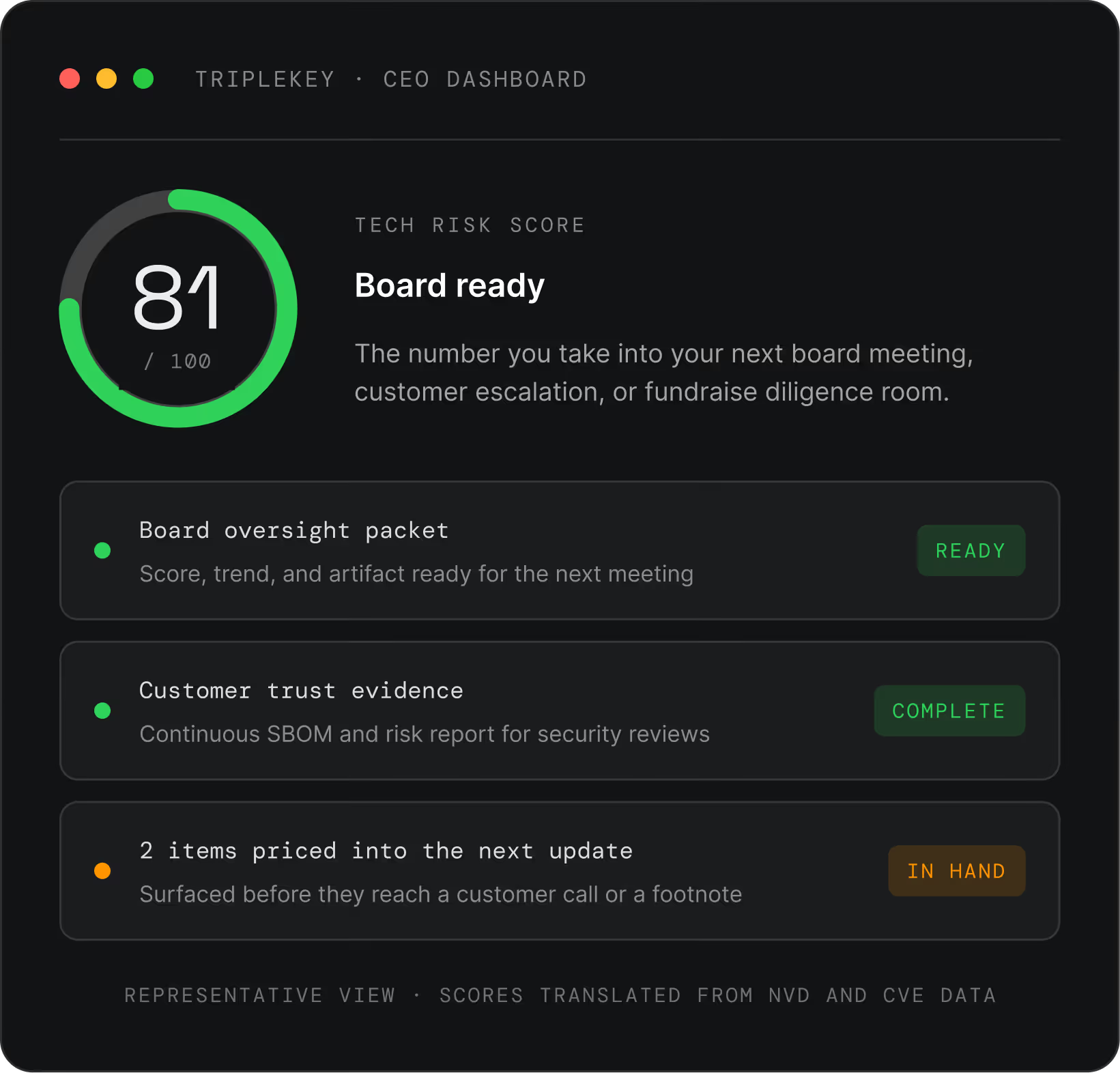
You ask for the number. Your developer produces it in 30 seconds.
Getting your first risk score and evidence packet does not require you to touch a line of code. Your job is to start the trial and ask for the artifact. The technical work belongs to the person who already owns it.
01/03 You sign up
02/03 Engineering connects it
03/03 You get the number
Tech Risk Score
Continuous SBOM
Buyer Evidence Packet

Walk into the next forecast call with the number.
The next time your CEO, your CFO, or your largest customer's CISO asks whether you can quantify your software risk, have a score and a packet ready instead of a hope. Start a free trial, invite your engineering lead, and put visibility behind every deal in your pipeline.