Software risk is a product risk now. Can your roadmap survive what is hiding in it?
of code in the average commercial application is open source. The components you ship that you did not write are the surface your customers judge you on.
from public CVE disclosure to first observed exploit. Roughly a third hit on or before disclosure, which means your next sprint plan is already stale on day one.
average time to contain a supply chain breach. That is two quarters of roadmap velocity bleeding into unplanned remediation, customer calls, and trust repair.
of large companies by revenue now call third party and supply chain risk their greatest cyber challenge. These are the buyers stalling your enterprise deals in security review.
Software risk stopped being a security backlog and became a roadmap variable that decides what you can ship.
For years this sat inside the security backlog. It was an engineering hygiene question that someone two levels down owned, and you saw a list of patch tickets once a quarter that never seemed to move. That arrangement worked when the product cost of software risk was small enough to absorb without modeling it on the roadmap.
That world is gone. Enterprise procurement teams now block deals on SBOM questions your AE cannot answer. The components you depend on ship vulnerabilities faster than your release train can absorb them. A single zero day on a popular library can wipe a sprint and reset a launch date. Customer trust pages, public security ratings, and post incident reviews now influence renewal and net new in ways that show up directly in your retention dashboard. And the engineering hours you were counting on for the next feature get pulled, without warning, into firefighting work no one put on the roadmap.
A security backlog item
A roadmap variable you defend
An engineering deep dive
A launch readiness gate you sign
A customer trust assumption
A churn risk you forecast
An open source dependency call
A product liability you own
That is why this guide exists. Not to turn you into a security buyer, but to make the risk inside your roadmap a number you can plan around, instead of a surprise that bumps the plan.
The product questions you cannot answer yet.
These are not technical questions. They are the questions you get asked in a quarterly roadmap review, a launch readiness meeting, a top customer escalation call, or a CEO one to one before the board meeting. Read each one and ask yourself honestly whether you could answer it today, with numbers, not from memory and not by saying you will follow up with engineering.
How many engineering hours next quarter will be lost to unplanned remediation rather than shipping your roadmap?
Which features on your roadmap are quietly blocked, slowed, or scoped down because of a component risk no one surfaced to you?
How much of your enterprise pipeline is stalled in security review, and what would unblock it?
If a zero day drops on a critical dependency tomorrow, how fast can you tell your largest customers exactly what is exposed and what is not?
What is the all in cost of invisible software risk on your roadmap today?
The cost is rarely one event. It is the launch that slipped a quarter because a critical library shipped a vulnerability the week before GA. It is the enterprise deal that closed late because procurement asked for an artifact engineering had to build from scratch. It is the customer who churned quietly after an incident no one publicly attributed to your product. It is the feature you scoped down to ship on time, that your top three customers now treat as a gap. It is the engineering team you keep hiring against, while a quarter of their capacity disappears every cycle into work no one put on the roadmap. Invisible risk does not stay invisible. It surfaces in the meetings where your roadmap, your retention, and your reputation are being judged.
The same blind spot, in the three rooms where you sit.
The underlying gap is the same in each room. What changes is who is in the room with you, and what is on the line when it surfaces. As CPO you are in all three.
Your engineering hours are bleeding into work that no one put on the plan.
Every CVE on a critical dependency forces a trade. Senior engineers are the first to be pulled, and they are the engineers your hardest features depend on. When you can see the risk coming, you can plan around it. When you cannot, your committed roadmap quietly becomes a best effort roadmap, and the meeting where you explain why is the one that ends careers.
Your largest customers are grading you on the answer you give in the first 48 hours.
When a major incident hits a popular open source library, your enterprise customers are not waiting for a blog post. They are on a call with their CISO asking whether your product is exposed and what you are doing about it. A precise, current answer becomes a renewal asset. A vague answer becomes a churn flag, and it travels through their procurement network for a year.
Your GA date is at the mercy of a component you did not pick.
A pre launch surprise from a transitive dependency is the most expensive kind of bug, because it lands when marketing, sales, and customer success have already invested. Without continuous visibility, your launch readiness review is an act of faith. With it, your readiness checklist is a single artifact and the launch ships on the date you committed to the board.
And at Series A and B, there is no Chief Product Security Officer to hide behind.
At your stage there is rarely a dedicated product security leader and often no AppSec function at all. When the CEO, the CRO, or the largest customer asks how your product handles a fresh supply chain incident, the question lands on you. This guide exists so that when it does, you can answer with a score, a trend, and an artifact, instead of a promise to circle back with engineering.
Three rooms. Three independent voices. One conclusion.
These are not vendors. They are the reinsurer pricing the market, the global advisor watching the C suite, and the board association overseeing your directors. When the people pricing risk, advising boards, and shaping governance all describe the same shift in the same year, the shift is the consensus, not a marketing claim.

Security cannot be a feature anymore. It has to be the foundation. Organizations that keep treating supply chain issues as isolated security problems will keep playing whack a mole.
Jagadeesh Kunda
Chief Product Officer and Co-Founder, Oleria. A peer CPO on what supply chain risk now means for product strategy.
Organizations are striving to balance innovation with security, embracing AI and automation at scale, even as governance frameworks and human expertise struggle to keep pace.
World Economic Forum
In collaboration with Accenture. The velocity vs governance tradeoff is now the defining product question of the year.
By 2025, 60 percent of organizations building or procuring critical infrastructure software will mandate and standardize SBOMs in their software engineering practice, up from less than 20 percent in 2022.
Gartner
The buyers your AE is selling into are about to require what most product orgs cannot yet produce on demand.
What invisible risk has cost the product orgs that did not see it coming.
None of these are worst case scenarios. They are documented averages drawn from independent research and government reporting. The point is not fear. The point is that the cost is real, measurable, and already being paid in roadmap slippage, customer churn, and engineering hours by product teams that assumed someone two levels down was watching.
Now run the math on your own revenue.
The ledger above shows industry averages. Plug in your ARR, deal size, and launch cadence, and see what invisible software risk is actually costing your product org in revenue and roadmap velocity.
None of this asks you to evaluate a security tool. It asks you to put a number on a risk already deciding what your team ships.
Every consequence above traces back to the same root cause. The risk was changing daily, no one in a position of product accountability could see it in time, and no one could attach a clean answer to it for the customer call, the procurement form, or the launch readiness review. The fix is not a bigger security backlog. It is continuous, plain language visibility into the components your product is built on, so the risk becomes a planning input you bring to the roadmap, instead of a surprise that bumps it. That is the entire reason TripleKey exists.
The math your roadmap is already running, whether you watch it or not.
You will quantify this risk eventually, either by modeling it on your roadmap or by absorbing it in slipped launches and churned customers. These are the four lines a CPO usually adds together. Each one on its own exceeds the annual cost of TripleKey. The combined total is not a question of return, it is a question of magnitude.
One number you can take into any roadmap review, launch gate, or customer call.
TripleScan continuously scans your codebase and the components it depends on, then translates everything it finds into a single Tech Risk Score from 0 to 100. You do not read code. You read the score, the same way you read NPS or DAU, and you walk into the roadmap review, the launch readiness meeting, or the top customer escalation with it ready.
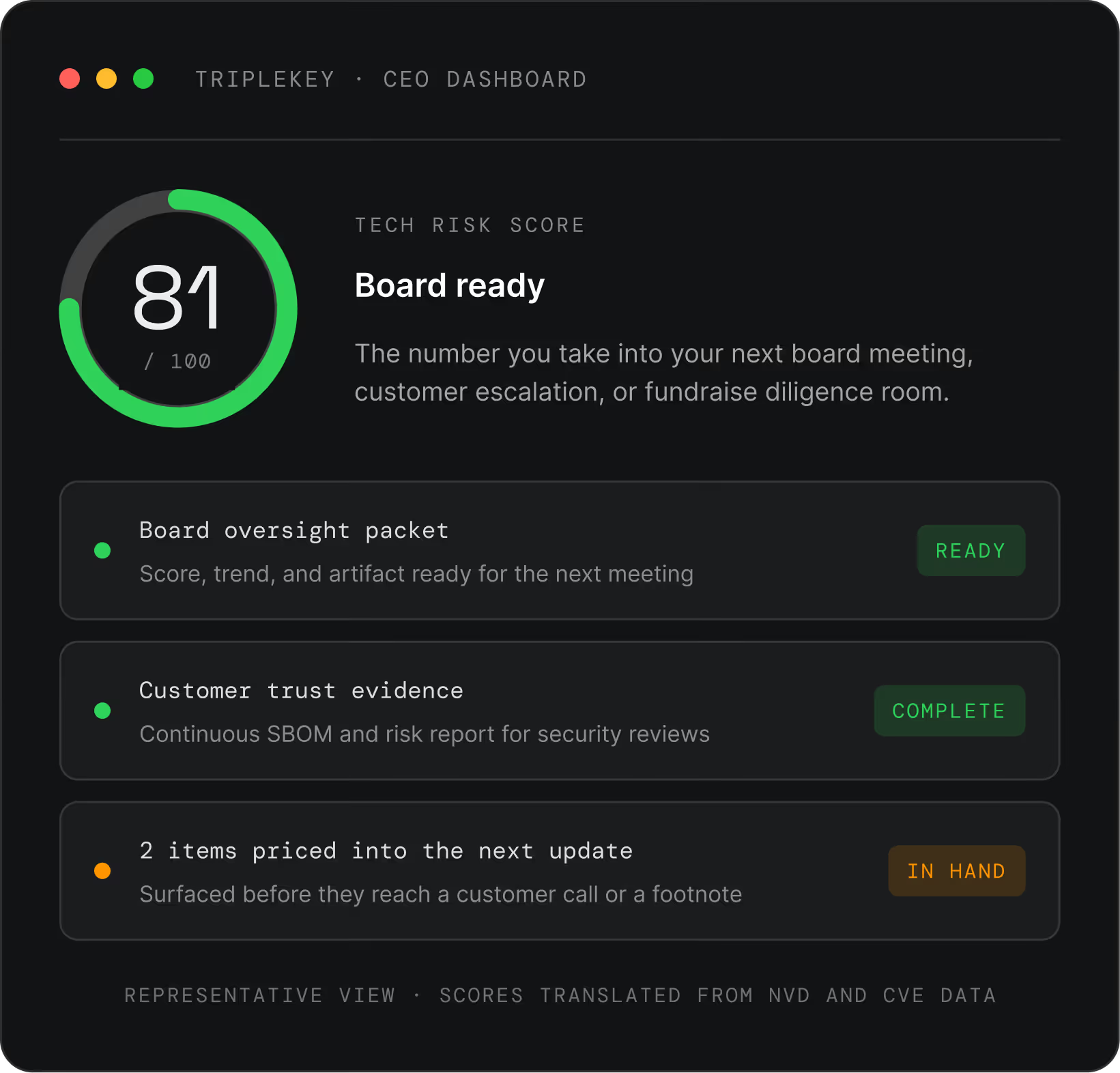
You ask for the number. Your developer produces it in 30 seconds.
Getting your first risk score does not require you to touch a line of code. Your job is to start the trial and ask for the number. The technical work belongs to the person who already owns it.
01/03 You sign up
02/03 Engineering connects it
03/03 You get the number
Tech Risk Score
Continuous SBOM
Launch Readiness Packet

Walk into the next roadmap review with the number.
The next time your CEO, your largest customer, or your launch readiness review asks whether you can quantify the risk inside your product, have a score ready instead of a hope. Start a free trial, invite your engineering lead, and see exactly where your roadmap stands.