
Operational resilience runs on software you did not write. Can you see it?
average time to contain a supply chain breach, the longest of any vector, and the longest your operations stay in incident mode.
of breaches now involve a third party or supply chain compromise, double the rate just one year earlier
median time from public disclosure to first observed exploit. Roughly a third of exploits hit on or before disclosure day.
of large companies by revenue now call third party and supply chain risk their greatest cyber challenge, up from 54 percent.
Software risk stopped being an engineering ticket and became an operating risk you run.
For years this sat inside engineering. It was a backlog item handled below your line of sight, surfaced once a quarter as a status update on a slide you skimmed. That arrangement worked when the operating consequences of software risk were small enough to absorb without coordinating across functions.
That world is gone. Customer escalations now arrive within hours of a CVE disclosure, asking what you run, how you know, and when you patched. Regulators expect a documented program with an owner, a process, and an artifact. Enterprise customers write SLA language and incident notification clocks into their contracts that your customer success team has to operate against. New hires onboard into a stack that grew faster than the operating playbook around it. The exposure now spans engineering, security, support, customer success, legal, and procurement, and the person who has to make those functions move together is you.
An engineering backlog item
A risk register entry you operate against
A patch cycle owned downstream
A customer escalation you have to answer
A quarterly status slide
A live number in your operating review
A single function's job
A cross functional process you orchestrate
This guide is to give you the evidence trail behind a control you already attest to.
The operating questions you cannot answer yet.
These are not technical questions. They are the questions you get asked at a Monday operating review, a customer escalation call, a vendor risk review, or a scaling decision with the executive team. Read each one and ask yourself honestly whether you could answer it today, with numbers, not from memory and not by saying you will follow up.
When a critical CVE drops at 4 PM on a Friday, can your company move as one operation?
Can you keep your SLA and uptime commitments under a supply chain disruption you did not cause?
How many of your operating processes secretly depend on a single component you do not actively monitor?
When you scale headcount or volume next quarter, does your risk posture scale with you or against you?
What is the all in operational cost of invisible software risk on your company today?
The cost is rarely a single event. It is the customer who escalates because you took twelve hours to confirm whether you ran the vulnerable component. It is the support team that opens duplicate tickets because nobody had a shared inventory. It is the customer success manager who loses a renewal because procurement asked for an SBOM and the answer took three weeks. It is the engineer who spends a sprint chasing a vulnerability that turned out not to affect you, because nobody could verify it quickly. It is the executive team that approves a scaling plan that quietly increases concentration risk. Invisible operational risk does not stay invisible. It surfaces in the meetings where your delivery is being judged.
The same blind spot, in the three rooms where you sit.
The underlying gap is the same in each room. What changes is who is in the room with you, and what is on the line when it surfaces. As COO you are in all three, every week.
The executive team wants a number, not an update.
Your Monday or Tuesday operating review is where the executive team asks how the company is performing against the plan. Software risk now belongs on that agenda alongside churn, NPS, and pipeline. When the CEO asks for your number, the answer that lands is a current score and a trend line. A reassurance from engineering, two functions away, no longer survives a serious operating review.
Your customers want to know within hours, not weeks.
When a major CVE breaks, every enterprise customer's vendor risk team sends a questionnaire. Your support, customer success, and engineering teams answer the same questions, multiple times, often inconsistently. A continuous inventory and risk score is the artifact that turns five days of scrambling into one consistent statement you can send within hours. The customers who get a clean answer remember it. The customers who do not, escalate.
Your vendor program and your continuity plan share one missing input.
The components inside your software are vendors too, just unregistered ones. Your vendor risk program and your business continuity plan both assume you know what you depend on. Without a continuous SBOM, both documents inherit the same blind spot. A documented inventory closes the gap between what your vendor program says and what your business actually runs on.
And at Series A and B, the function that owns this is yours, whether the title says so or not.
At your stage there is usually no Chief Risk Officer, no dedicated GRC team, and often no full time security leader. The cross functional coordination that this risk requires lives between functions, which means it lives with you. This guide exists so that when the executive team, the customer, or the auditor asks for the number, you can put a score, a trend, and an artifact on the table, rather than a promise to circle back with engineering.
Three rooms. Three independent voices. One conclusion.
Three independent voices. The analyst naming the operating problem, a peer COO running the playbook inside healthcare technology, and the regulator setting the clock. When the operating world, the operator's seat, and the rule book all describe the same shift in the same year, the shift is consensus, not a marketing claim.

A lack of clarity around ownership and budget for identifying and managing cybersecurity risks, the breadth of supply chain IT and cyber physical systems that require protection, and the large number of multitier partners that complicates visibility into and management of third party cyber risk.
Gartner
Naming the three obstacles operators run into when they try to own this risk.
In an industry as complex as healthcare tech, having a clear window into our development lifecycle is critical. TripleKey provides the high level visibility I need to ensure our security posture is ironclad and our market differentiation is backed by data.
Chief Operating Officer
Healthcare Technology Company. TripleKey customer.
Companies must determine whether a cybersecurity incident is material without unreasonable delay after discovery, and disclose within four business days of that determination.
U.S. Securities & Exchange Commission
Final rule on cybersecurity risk management, strategy, governance, and incident disclosure. The clock enterprise procurement now applies to private vendors too.
What invisible risk has cost the operators who did not measure it.
None of these are worst case scenarios. They are documented averages drawn from independent research and government reporting. The point is not fear. The point is that the cost is real, measurable, and already being paid by companies that assumed someone two functions away was watching.
Now run the math on your own revenue.
The ledger above shows industry averages. Plug in your ARR, deal size, and renewal base, and see what invisible software risk is actually costing your operation.
None of this asks you to evaluate a security tool. It asks you to put a single source of truth under an operating process you already run.
Every consequence above traces back to the same root cause. The risk was changing daily, no one in a position of cross functional accountability could see it in time, and no team could attach a shared number to it during an operating review, an incident, or a customer escalation. The fix is not a bigger security budget. It is continuous, plain language visibility into a risk your operations already absorb, so it becomes a number you bring to the room instead of a surprise that walks in through the support queue. That is the entire reason TripleKey exists.
The math your seat will run anyway.
You will quantify this risk eventually, either by modeling it or by absorbing it in cycle time. These are the four lines a COO usually adds together. Each one on its own exceeds the annual cost of TripleKey. The combined total is not a question of return, it is a question of magnitude.
One number you can take into any operating review, incident, or customer call.
TripleScan continuously scans your codebase and the components it depends on, then translates everything it finds into a single Tech Risk Score from 0 to 100. You do not read code. You read the score, the same way you read NPS or uptime, and you walk into the operating review, the incident bridge, or the customer escalation with it ready.
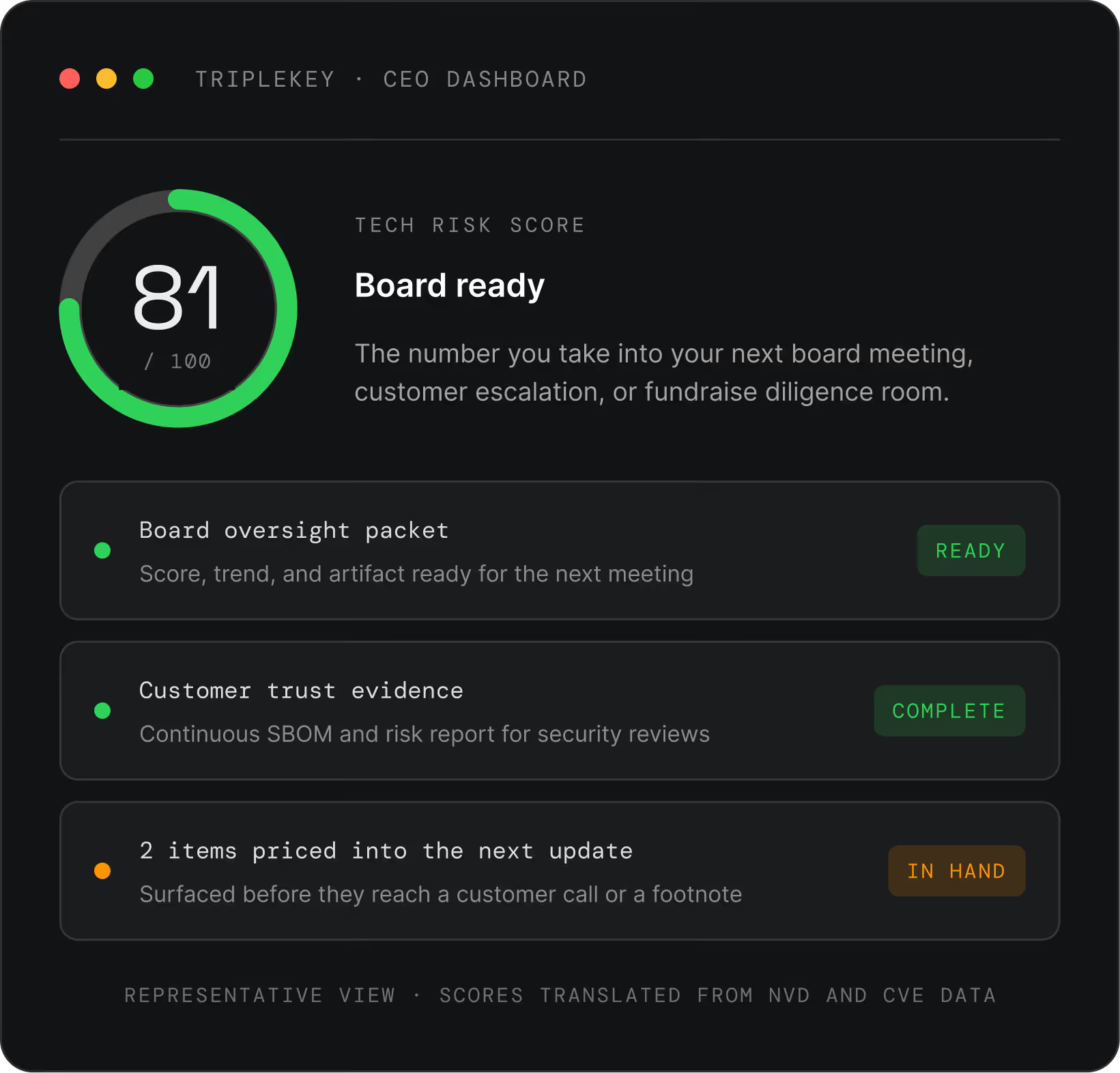
You ask for the number. Your developer produces it in 30 seconds.
Getting your first risk score does not require you to touch a line of code. Your job is to start the trial and ask for the number. The technical work belongs to the person who already owns it.
01/03 You sign up
02/03 Engineering connects it
03/03 You get the number
Tech Risk Score
Continuous SBOM
Ops Packet

Walk into the next room with the number.
The next time your CEO, your customer, or your auditor asks whether you can quantify your software risk, have a score ready instead of a hope. Start a free trial, invite your engineering lead, and see exactly where your operation stands.