Brand trust is a software problem now. Can you prove yours?
average cost of a US data breach, and the figure your brand gets associated with in every retelling of the incident.
of breaches now involve a third party or supply chain compromise, doubling the number of company names attached to each story.
average time to contain a supply chain breach, the longest of any vector, and the longest your brand stays in the cycle.
of large companies by revenue now call third party and supply chain risk their greatest cyber challenge, the same buyers your team is selling into.
Software risk stopped being an engineering story and became a brand story.
For years this lived inside the engineering org. It was a backend concern that security or platform owned, and the only time it touched marketing was when a press release went out about a peer in the category. That arrangement worked when buyers, customers, and the press treated software hygiene as an internal matter.
That world is gone. Enterprise procurement now sends security questionnaires before they look at your demo. Customers read your trust page before they read your pricing. Analysts ask about software dependencies in briefings. Crisis comms cycles for software supply chain incidents now run longer than any other breach category, which means the brand is exposed for the better part of a year when something goes wrong. The CMO is the one asked to vouch for the company in every one of those rooms, and the answer cannot be a forwarded email from engineering.
A backend engineering concern
A trust narrative you defend in market
A press release if something happens
A procurement question on every enterprise deal
A topic your CISO speaks to
A topic your buyers ask the CMO directly
A talking point in a future incident
A standing line in your competitive positioning
That is why this guide exists. Not to turn you into a security buyer, but to put a measurable, public trust signal on a story you already own.
The brand questions you cannot answer yet.
These are not technical questions. They are the questions you get asked in an enterprise win review, an analyst briefing, a board update on brand resilience, or a crisis comms war room the morning a peer in your category gets breached. Read each one and ask yourself honestly whether you could answer it today, with numbers, not from memory and not by saying you will follow up.
When a peer in your category gets breached this quarter, can your team produce the trust evidence buyers will ask for in the next 48 hours?
What percentage of your enterprise pipeline is stalled in security review right now?
Can you tell your board what your brand looks like the morning after a breach, with numbers, not adjectives?
Does your marketing stack itself meet the standard you promise your customers?
What is the all in cost of invisible trust risk on your brand today?
The cost is rarely one event. It is the enterprise deal that slipped a quarter because procurement asked for an SBOM your team could not produce. It is the customer that renewed at a discount because they no longer believe the trust story without evidence. It is the analyst briefing that reset your category position because you could not answer a question about software supply chain. It is the peer breach that pulled your prospects offline for a week. It is the breach that becomes a permanent restatement of your brand, the kind that follows the company name long after the incident is closed. Invisible trust risk does not stay invisible. It surfaces in the rooms where your brand is being judged.
The same blind spot, in the three rooms where you sit.
The underlying gap is the same in each room. What changes is who is in the room with you, and what is on the line when it surfaces. As CMO you are in all three.
Your sales team is selling into a security review they cannot win without you.
Procurement teams now lead with security questionnaires, SBOM requests, and trust page reviews before the demo team is even in the room. When your marketing org has a public, evidenced trust posture and a ready RFP packet, sales cycles compress. When it does not, deals stall in review for weeks, conversion drops, and the cost lands directly on the pipeline number you signed up for.
Your team is drafting a statement against a clock you did not start.
The morning a peer is breached, or worse, the morning you are, the comms team has hours to ship a response. The CMOs who hold the brand through it are the ones with a current score, a public artifact, and a playbook drafted in advance. The rest write the statement from scratch while the news cycle moves without them, and the brand absorbs the gap.
Your board is asking you about brand resilience, not just brand health.
Brand health used to be NPS, awareness, and share of voice. Brand resilience is the newer board metric, and it is the one the CMO now owns. The board wants to know how the brand survives a software incident, and the answer that lands is a documented trust posture, a current score, and an artifact you can point them to. Without it, the brand health story sits on a foundation no one has measured.
And at Series A and B, there is no Chief Trust Officer to hand it to.
At your stage there is usually no Chief Trust Officer, often no dedicated communications crisis lead, and the CISO is heads down on engineering. When the board, the analyst, the journalist, or the enterprise buyer asks who speaks for the brand on software risk, the question comes to the CMO. This guide exists so that when it does, you can put a score, a trend, and a public artifact on the table, rather than a promise to circle back with engineering.
Three rooms. Three independent voices. One conclusion.
Three independent voices. The trust researcher naming the gap, the analyst measuring how buyers respond to it, and the regulator setting the clock the comms team has to ship against. When the people who measure trust, study B2B buying, and write the disclosure rules all describe the same shift in the same year, the shift is the consensus, not a marketing claim.

Grievance is now the dominant emotion shaping how people relate to institutions. Six in ten default to distrust until they are shown reason to believe. The brands that close that gap do it with evidence, not promises.
Edelman 2025 Trust Barometer
Annual study of trust across 28 countries. The authoritative source for how stakeholders form belief in institutions.
Customer trust now ranks as the most important driver of brand and demand performance, ahead of advertising and content. CMOs without a defensible trust signal lose preference before they enter the consideration set.
Gartner
Naming trust as the new lead measure for marketing performance, ahead of media spend and content output.
Companies must determine whether a cybersecurity incident is material without unreasonable delay after discovery, and disclose within four business days of that determination.
U.S. Securities & Exchange Commission
Final rule on cybersecurity disclosure. The four day clock the CMO comms team is now expected to ship against, and the standard enterprise procurement now applies to private vendors too.
What invisible trust risk has cost the CMOs who did not quantify it.
None of these are worst case scenarios. They are documented averages drawn from independent research and government reporting. The point is not fear. The point is that the cost is real, measurable, and already being paid by brands that assumed someone two levels down was watching.
Now run the math on your own revenue.
The ledger above shows industry averages. Plug in your ARR, average enterprise deal size, and renewal base, and see what invisible trust risk is actually costing your brand and your pipeline.
None of this asks you to evaluate a security tool. It asks you to put a trust signal on a story you already tell.
Every consequence above traces back to the same root cause. The risk was changing daily, no one in a position of brand accountability could see it in time, and no one could attach a public, evidenced signal to it for the buyer, the analyst, or the board. The fix is not a bigger security budget. It is continuous, plain language visibility into a risk you already speak to, so it becomes a public artifact you bring to the room instead of a surprise the press brings to you. That is the entire reason TripleKey exists.
The math your seat will run anyway.
You will quantify this risk eventually, either by modeling it or by absorbing it in pipeline drag and brand erosion. These are the four lines a CMO usually adds together. Each one on its own exceeds the annual cost of TripleKey. The combined total is not a question of return, it is a question of magnitude.
One number you can put on your trust page, in your RFP, and in your next board update.
TripleScan continuously scans your codebase and the components it depends on, then translates everything it finds into a single Tech Risk Score from 0 to 100. You do not read code. You read the score, the same way you read NPS or brand health, and you publish it as the trust signal that lets your buyers, your customers, and your analysts evaluate the brand in real time.
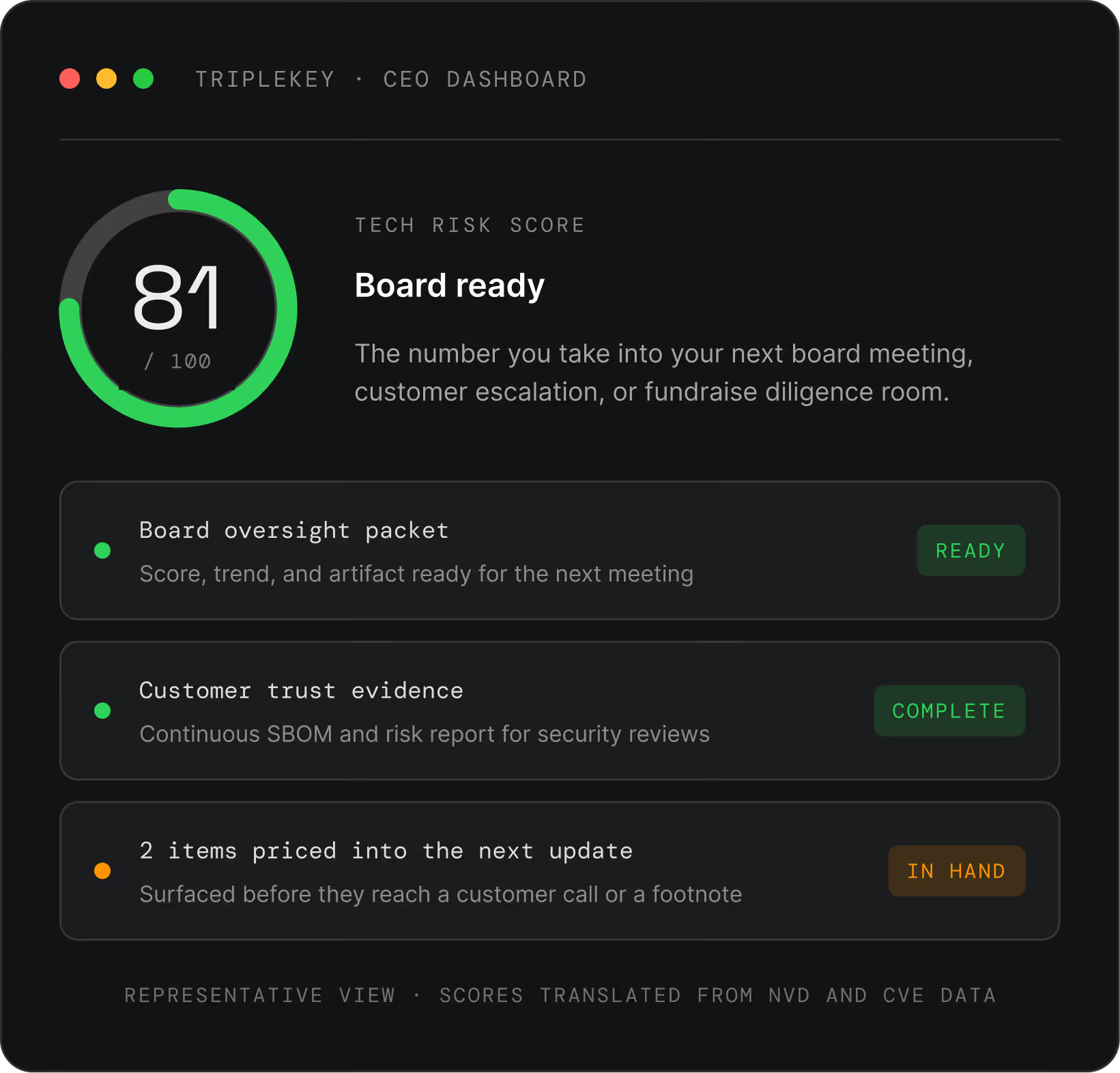
You ask for the number. Your developer produces it in 30 seconds.
Getting your first trust score does not require you to touch a line of code. Your job is to start the trial and ask for the number. The technical work belongs to the person who already owns it.
01/03 You sign up
02/03 Engineering connects it
03/03 You get the number
Tech Risk Score
Trust Page Artifact
RFP Packet

Walk into the next room with the number.
The next time a buyer, a journalist, or your board asks whether you can evidence the trust story your brand tells, have a score ready instead of a hope. Start a free trial, invite your engineering lead, and see exactly where you stand.