
and whether one headline rewrites your company.
Software risk is now company defining. Can you put a number on yours?
average cost of a US data breach, at an all time high. The figure that lands on your P&L, your press, and your customer list at the same time.
of breaches now involve a third party or supply chain compromise, double the rate just one year earlier. A single incident now averages five downstream victims.
average time to contain a supply chain breach, the longest of any vector. That is how long your customers, your board, and the press stay watching the story.
of the world's largest companies by revenue, the same buyers you sell into, now formally call third party and supply chain risk their greatest cyber challenge.
Software risk stopped being an engineering line item and became a CEO problem.
For years this sat inside the engineering function. It was a tooling question the security or platform team owned, and it touched your desk once a year, if at all. That arrangement worked when the consequences were small enough to be absorbed by the people closest to the code.
That world is gone. Enterprise buyers now route security questions into the contract and stall the deal when the answer is thin. A single third party incident drives weeks of customer escalations, board fire drills, and press queries to your office. Growth stage investors and acquirers price your software posture into your valuation, and you do not get to argue the assumptions in a diligence room. Boards are now formally accountable for cyber oversight, and they ask you, not your CTO, for the number.
A line item in engineering
A category you defend to the board
A renewal someone else signed
A trust question your top customer asks
A pipeline note no one investigated
An ARR forecast variable you defend
A headline you could not see coming
A score, a trend, and an artifact
That is why this guide exists. Not to turn you into a security buyer, but to put a number on a risk you already answer for.
The questions you cannot answer yet.
These are not technical questions. They are the questions you get asked at a customer escalation call, a board meeting, an investor update, or a fundraise diligence room. Read each one and ask yourself honestly whether you could answer it today, with numbers, not from memory and not by saying you will follow up.
When your largest customer asks how you protect them from a third party software incident, what is your answer?
How many dollars of ARR are sitting in security review right now, and how exposed is your forecast?
If a third party software incident hit tomorrow, could you tell your board, your customers, and the press what you knew, when, and what you did?
If your lead investor opened your data room today, what gets priced down that you did not flag first?
What is the all in cost of invisible software risk on your company today, across revenue, valuation, and reputation?
The cost is rarely one event. It is the enterprise deal that slips a quarter because procurement asked for an SBOM you cannot produce. It is the round that prices lower because diligence found a component you did not know was there. It is the customer that quietly downgrades after a competitor's incident, because you could not explain why you are different. It is the headline that becomes a permanent restatement of your company's story, the kind that follows the brand long after the incident is closed. Invisible risk does not stay invisible. It surfaces in the rooms where your company is being judged.
The same blind spot, in the three rooms where you sit.
The underlying gap is identical in each room. What changes is who is in the room with you, and what is on the line when it surfaces. As CEO you are in all three.
Your directors are formally accountable, and they look to you for the number.
Cyber oversight is now a standing board responsibility, codified by regulators, by insurers, and by every governance body the directors answer to. When a director asks how the company quantifies and monitors third party software risk, the answer that lands is a documented program with a current score and a trend. Assurance from management does not survive a serious board anymore. Especially not yours.
Your largest accounts are asking, and a thin answer is a stalled deal.
Enterprise buyers now route security through procurement, legal, and a security review of their own. When you can produce a current inventory and a continuous risk score, the deal moves. When you cannot, it sits. Most of the time you will never be told that is why. The deal simply slips, and the slip is logged as a timing issue. That is the cost you cannot see from the CEO seat without help.
Your next round or exit is partly underwritten by your posture.
Growth stage investors and acquirers treat software posture as a standard line in diligence. A clean, evidenced posture supports your valuation and shortens the cycle. A gap discovered by the other side becomes leverage to re-price the deal in their favor. You want to walk in with the number, not have it walked in to you. At this stage, valuation is fragile and a single surprise can move the round by a multiple.
And at Series A and B, there is no CISO to hide behind.
At your stage there is usually no Chief Information Security Officer and often no full security function. When the board, your largest customer, or the lead investor asks for the number, the question comes to you personally. When the press calls during an incident, they ask for you by name. This guide exists so that when those calls happen, you can put a score, a trend, and an artifact on the table, instead of a promise to circle back with engineering.
Three rooms. Three independent voices. One conclusion.
These are not vendors. They are the reinsurer, the U.S. securities regulator, and the board association. When the people who underwrite your cyber program, set your disclosure obligations, and oversee your directors all describe the same shift in the same year, the shift is the consensus, not a marketing claim.

More than two thirds of large organizations experienced at least one third party cybersecurity incident in the past twelve months.
Munich Re
Global reinsurer. The carrier behind a large share of the cyber market.
Whether a company loses a factory in a fire, or millions of files in a cybersecurity incident, it may be material to investors. Companies and investors alike would benefit if this disclosure were made in a more consistent, comparable, and decision useful way.
Gary Gensler
Then Chair, U.S. Securities and Exchange Commission
Intention must now turn into structured governance. It is not enough to simply talk about risk. Boards must evolve their practices to lead through it.
Peter Gleason
President & CEO, National Association of Corporate Directors
What invisible risk has cost the CEOs who did not look.
None of these are worst case scenarios. They are documented averages drawn from independent research and government reporting. The point is not fear. The point is that the cost is real, measurable, and already being paid by companies whose CEO assumed someone two levels down was watching.
Now run the math on your own revenue.
The ledger above shows industry averages. Plug in your ARR, deal size, and renewal base, and see what invisible software risk is actually costing your company.
None of this asks you to evaluate a security tool. It asks you to put a price on a risk you already carry.
Every consequence above traces back to the same root cause. The risk was changing daily, no one in a position of executive accountability could see it in time, and no one could attach a number to it for the board, the customer, or the investor. The fix is not a bigger security budget. It is continuous, plain language visibility into a risk you already answer for, so it becomes a number you bring to the room instead of a surprise someone else brings to you. That is the entire reason TripleKey exists.
The math your seat will run anyway.
You will quantify this risk eventually, either by modeling it or by absorbing it on your forecast. These are the four lines a CEO usually adds together. Each one on its own exceeds the annual cost of TripleKey. The combined total is not a question of return, it is a question of magnitude.
One number you can take into any board, customer, or fundraise room.
TripleScan continuously scans your codebase and the components it depends on, then translates everything it finds into a single Tech Risk Score from 0 to 100. You do not read code. You read the score, the same way you read a credit rating, and you walk into the board meeting, the customer escalation, or the fundraise diligence room with it ready.
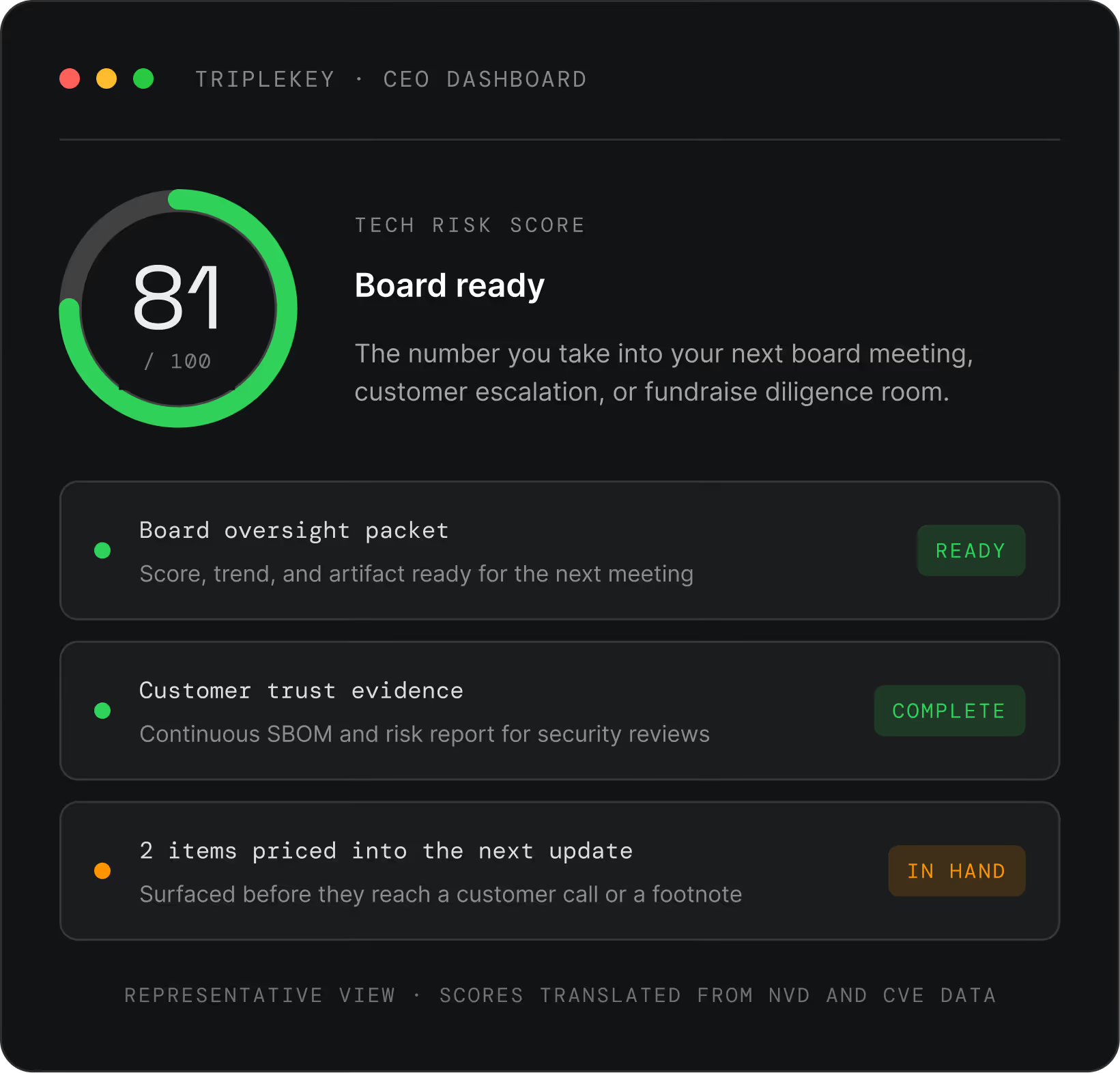
You ask for the number. Your developer produces it in 30 seconds.
Getting your first risk score does not require you to touch a line of code. Your job is to start the trial and ask for the number. The technical work belongs to the person who already owns it.
01/03 You sign up
02/03 Engineering connects it
03/03 You get the number
Tech Risk Score
Continuous SBOM
Board Packet

Walk into the next room with the number.
The next time your board, your largest customer, or your lead investor asks whether you can quantify your software risk, have a score ready instead of a hope. Start a free trial, invite your engineering lead, and see exactly where you stand.